
IV. TUeMechE#
IV.1. Mechanical engineering at TU/e#
The Department of Mechanical Engineering (ME) has been a core part of Eindhoven University of Technology (TU/e) since the university was founded in 1956.
The mission of ME is to perform long-term, world-class research within the mechanical-engineering domain on carefully selected topics that fit the university’s research profile and connect strongly to the technological interests of high-tech, internationally oriented industry in the Netherlands, particularly in Brainport Eindhoven. The department combines fundamental research with application-driven engineering and education, with the aim of educating engineers who can address future scientific, industrial, and societal challenges.
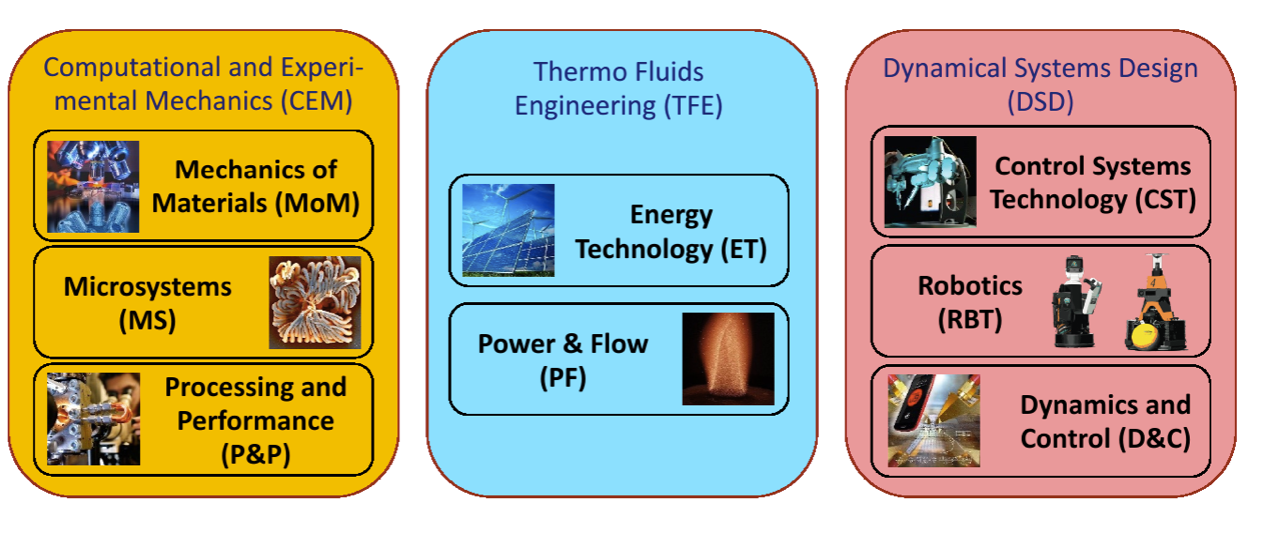
Structure of Mechanical Engineering at TU/e. The department organizes its research around three divisions: Computational and Experimental Mechanics (CEM), focused on mechanics and materials; Dynamical Systems Design (DSD), focused on systems, dynamics, and control; and Thermo Fluids Engineering (TFE), focused on heat and flow. Each division contains several research sections and groups. Across these divisions, fundamental understanding is combined with design, experimentation, computation, and manufacturing. The divisions are primarily concept- and method-oriented rather than tied to a single application domain, which allows expertise to be applied across high-tech systems, energy, healthcare, mobility, manufacturing, and robotics.
The Mechanical Engineering Bachelor’s program is part of the TU/e Bachelor College and provides a broad disciplinary foundation. Its learning lines include Mathematics, Design and Manufacturing, and learning lines connected to the three research divisions CEM, DSD, and TFE. Design and Manufacturing is particularly important because mechanical-engineering concepts ultimately have to be transformed into physical products, machines, production processes, and high-precision systems that can be manufactured, assembled, tested, and scaled.
The Mechanical Engineering graduate program is part of the TU/e Graduate School and includes the ME Master’s and PhD programs. The Master’s program combines a common mechanical-engineering foundation with specialization through the department’s research sections. Faculty members of the department provide most of the educational components in the Bachelor’s and Master’s programs.
IV.2. Research sections at ME#
The research sections show the breadth of modern mechanical engineering at TU/e. Two themes are especially visible across multiple sections:
Manufacturing and realization: mechanical engineering does not stop at analysis and design. Materials, processing, precision engineering, production technology, metrology, and system integration determine whether a concept can become a reliable physical product or production system.
Advanced robotics and autonomous systems: robotics combines mechanics, dynamics, actuation, sensing, control, perception, planning, and increasingly learning-based methods. At TU/e, robotics therefore connects naturally to both Control Systems Technology and Dynamics and Control, while also drawing on expertise in materials, manufacturing, and thermo-fluid systems.
|
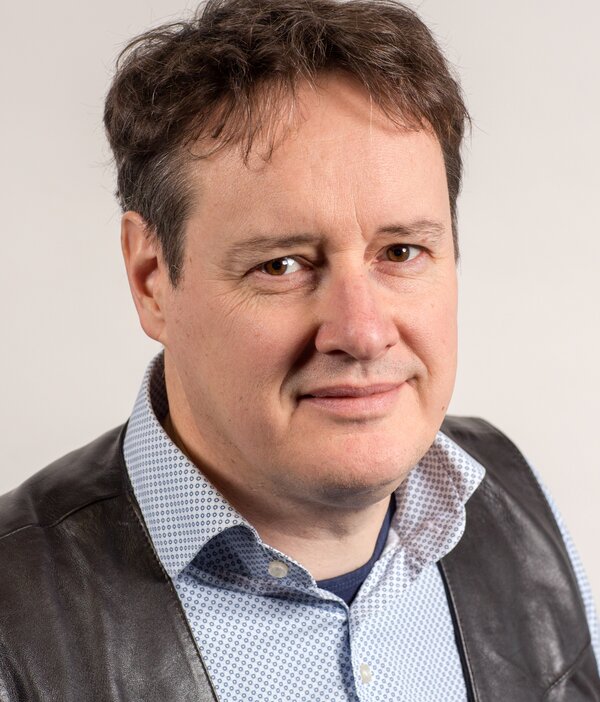
Prof. Marc Geers |
|
Prof. Jaap Den Toonder |
|
Prof. Markus Hutter |
|
Prof. David Smeulders |
|
Prof. Niels Deen |
|
Prof. Tom Oomen |
|
Prof. Rene van de Molengraft |
|
Prof. Simon Eugster |




IV.3. TUeMechE online#
|
See www.tue.nl/me for the official Eindhoven University of Technology website. |
|
See tuemeche.nl for the informal TUeMechE website hosting the Mechanical Engineering interactive lecture notes. |
|
The new TU/eMechE app provides mobile access to TUeMechE content and resources. Download the TU/eMechE app from the Apple App Store. |
|
Click here to visit and follow the departmental Instagram page. |
|
Click here to visit and follow the departmental LinkedIn page. |